Day 1: Using the Cryostat & Getting Acquainted

First Day Introductions

Today is August 6th; I just got back from my first day of interning with Dr. Tucker at John’s Hopkins Hospital! I started promptly at 8am when I met Dr. Tucker and her lab technician, Lisa, on the main floor of the Children’s Hospital.

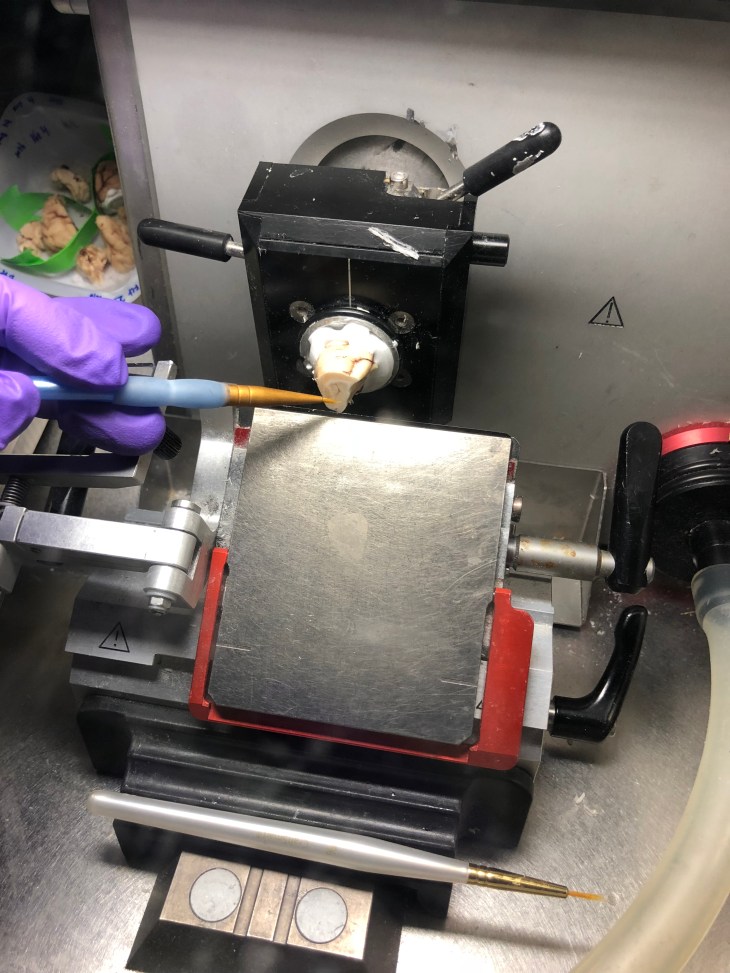
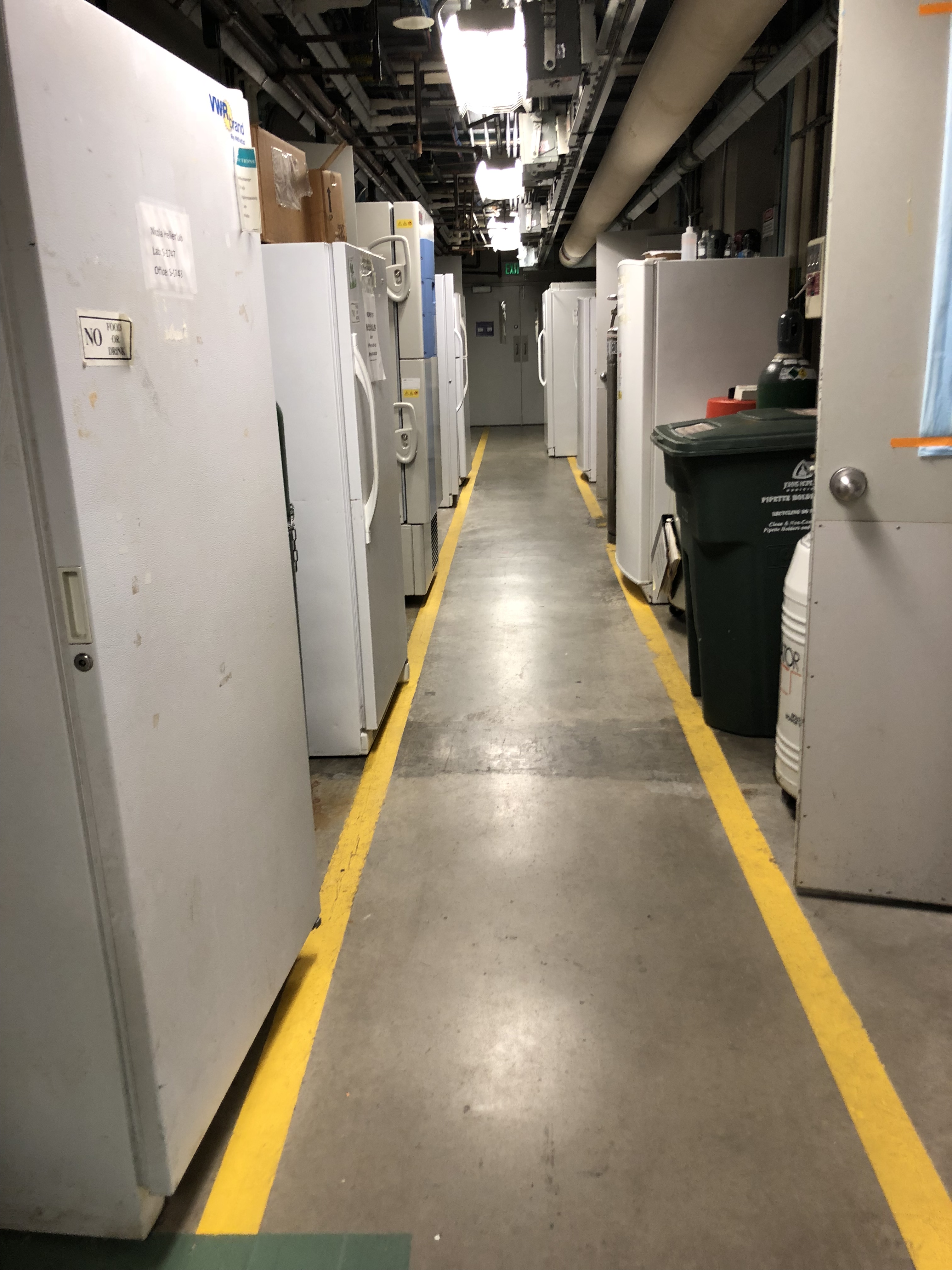
To start off the day, Dr. Tucker took me for a brief tour around her lab area where I would be working. We took a service entrance (which was very eerie as it was just lines and lines of freezers, marked -80 degrees Celsius) to get to her lab, and Lisa began to introduce me to the cryostat, which I would end up working with for a few hours. Once I got the hang of it, I was quickly labeling 5 slides at a time and slicing the right hemisphere of a rabbit from kit #4 exposed to TB. The slicing process and putting the specimen on the slide was the most meticulous work. First, you have to crank a lever to bring the specimen to the blade, and then you have to slowly wind it as it lowers to the blade. As this is happening and you are slicing the brain paper thin, you have to use a paintbrush (or two) to flatten the specimen out since it likes to curl in the freezing temperatures (basically, it was being kept at -20 degree Celsius, so I felt like my hands were stuck in a freezer all day). After I had about 5 slices on each slide, I would place them in the slide holder and put them back in the cryostat to keep them cool.

Below: Helping the specimen along the blade with a paintbrush so it doesn’t curl
IMG_4359

Repeat the process for about two hours, and then Dr. Tucker drops back in after a meeting to announce it was lunchtime. Cool!

Lunch was a great opportunity for me to ask some questions and for us to get to know each other a little bit more. I could go on for a long time about my questions and her answers, so at the end of each blog I’ll briefly cover what I asked and what she said!

After lunch, Dr. Tucker took me on a more extensive tour of the surrounding area. We left the children’s hospital and went to the research building, where I got to meet the rest of her research team. I quickly noticed a large number of females which made me excited! I got to watch her interact with her team as they discussed their findings on a certain experiment, and they effortlessly divulged into what they liked, didn’t like, didn’t expect, and how they wanted to modify things for next time. The amount of passion for their research was clearly evident in their conversations!

Once she had checked in with her team, she took me to where the rabbits and other test animals are kept. I had to put on a yellow smock and booties, in order to prevent the spread of some bacteria as we were in biohazard safety level 2. I got to see where the animals were kept, along with the rooms where they inject the TB virus and measure different elements with various tests. She showed me their PET and CT scanners, which look a lot like the ones we have, just much smaller. They also have special tubes to put the sedated animals in.

As we disposed of our smocks and booties, we headed up to talk with Dr. Tucker’s mentor, and I got to see their interactions with one another in terms of their research. They talked about a paper they want to publish, some revisions to make, and why they were necessary. It was very similar to revising papers with teachers at school!

We proceeded back to our original spot soon after. I got to go back to working with the cryostat, and I felt I finally had the hang of it. All of a sudden, it was 4pm, and it was time for me to head out! Time went by way faster than I expected. Dr. Tucker showed me how to clean up and dispose of what needed to be disposed, and then we headed out to the main entrance. She answered a few of my last minute questions and then we made plans for our second and third days together. She had to run off to another meeting, so I quickly said thank you and goodbye before heading out.

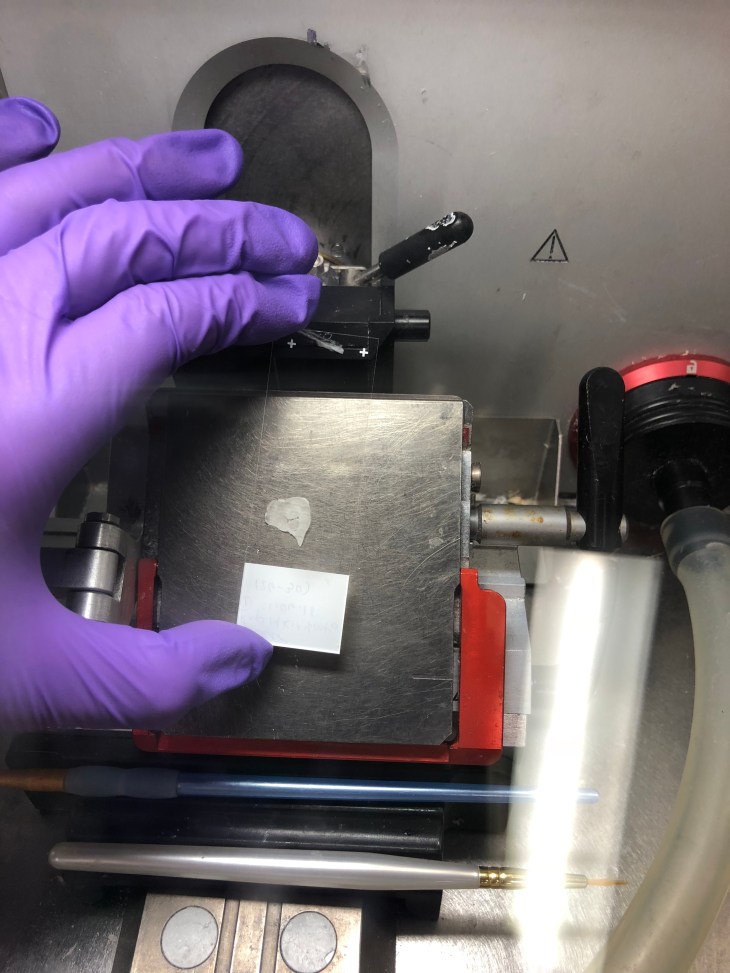
Below: placing the slide over the slice of the brain to adhere it to the slide
IMG_4366


Brief Questions with Briefed Answers

Q: What are the differences between the Biohazard safety levels?

A: The level depends on how the pathogen can be spread. A level 2 is most likely only through physical contact, while a level 3 could be airborne or through expulsion like a sneeze.

Q: Was it hard working with animals at first and has it gotten easier?

A: It was definitely hard at first. We euthanize them when they start getting sick to harvest their organs for research, so the animals never really feel any pain. I personally don’t do a lot of the injecting, our chemists and technicians do, so it’s also a bit easier to focus on what you need, in terms of research data.

Q: Obviously the brain is one of the major organs in terms of harvesting after death, since the injection site is in the brain. Are there any other organs you usually strive to get or want to study?

A: It depends on the case. In one experiment, we found that the pathogens had spread from the brain to the lungs through the lymphatic passages (or so we believe). So, in that case, we made sure we got at least the lungs and brain. In other cases, people have harvested the stomach, heart, intestines, etc. It really depends on your freezer space too!

Q: Why do you test with rabbits rather than mice or other animals? What is the best animal to do so with, and how do you translate that to humans (children) since our bodies don’t respond the same way to everything?

A: They really don’t, which is why some of our process and findings never translate to patients. It’s a lot of trial and error. In terms of what animals we use, we found that mice have a certain “knock out” gene or ability that can help us isolate parts of the body to watch for responses. However, their brain development happens mostly before they are born, unlike humans, so we found out that it was not the most effective for pediatric patients. We use rabbits because their development is very similar to human children (with the brain taking a year to develop immensely and the skull hardening after birth), so we knew our results were going to be similar to what it would be like with an infant or toddler. In the best case scenario, we could use monkeys, since they are the most similar to us, but monkeys are hard to come by due to price, and we can’t experiment the way we need to in order to find results (in terms of euthanizing & harvesting organs for research).


Day 2: Go With the Flow

What It’s Really Like Being a Lab Rat

This morning proved to be much different from the get-go. Instead of meeting Dr. Tucker, Lisa met me a few minutes after 8am to take me to the lab I worked in yesterday. She apologized to me, “Sorry, I was working on studying rabbit behavior on BSL3 today” as if it was an everyday occurrence. Well, I guess it is for her.

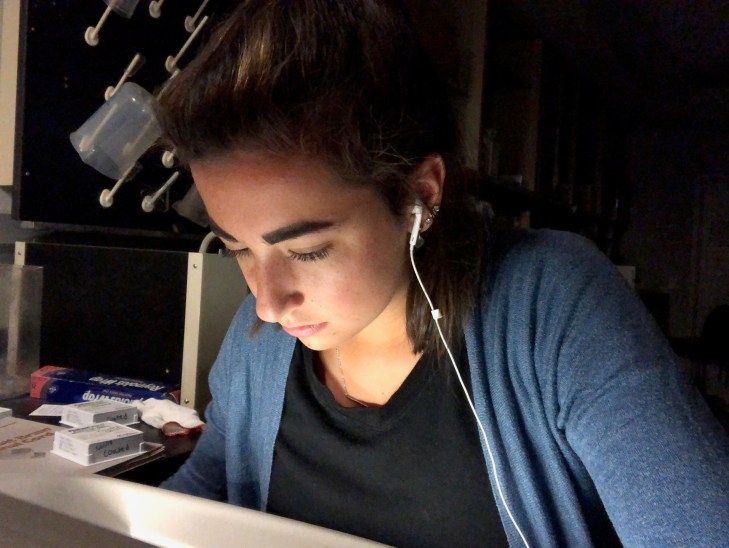
Once we got to the lab, I pretty much remembered how to get the cryostat set up. She watched me and made sure I found all the correct tools before bolting back out to go help with another experiment she was preparing. I quickly found myself alone in the lab, working with the same rabbit brain I was slicing the day before. However, today I was much more confident in my abilities. I grabbed my headphones, put an episode of Forensic Files on, put on fresh gloves, and got to work.

There was much more foot traffic in the lab today, and it was nice being able to get acquainted with some new faces! One woman in particular, Caroline, was doing some interesting work while training a new hire, whose name is Miles. We briefly introduced ourselves and I learned that she actually went to Mount DeSales and often admired RPCS’ crew tank and fields! If I hadn’t known she was a PhD student and already out of undergrad, I totally would have thought she was my age. She (and almost everyone in the lab for that matter) didn’t look much older than I did! I was quickly humbled by the sheer amount of intelligence and talent in the room as more engineers, chemists, and handlers entered the room to begin setting up a new machine. During one of the two times Dr. Tucker stopped by to check in on me, I asked her how old all of these kids were, and she explained that they were all mid or young twenties. In that moment, I truly realized that I was old and that this could be me in a few short years. My jaw could have dropped to the floor if I hadn’t been mid-slice.

Since Dr. Tucker was on call most of the day, she was visiting patients and doing other work, so I took a break for 45 minutes around noon to eat my lunch. Caroline and Miles actually invited me to eat lunch with them, so I gladly accepted the offer.

After lunch, I quickly went back to the lab to continue my cryostat-ing. I wanted to finish the section of the brain I had been working on. By 2pm, I had close to 95 slides finished, with 3-5 slices per slide. Between periods of 5 slides, I often closed the cryostat, warmed my stiff hands back up, and admired the work being done around me. Caroline explained what she was doing with pipettes and isolating a protein from the rabbits’ blood to tell if they had or hadn’t received treatment. Some of the wording went over my head (I wish I could understand it all), but it was very impressive watching her create solutions and seeing them change color (an indication of treatment vs. non-treatment).

While some fun chatter happened around me for the rest of the afternoon, I continued forging ahead on my rabbit brain while remaining friendly with the people around me. It was fun to hear their witty banter and their jokes (that weren’t so science-y I couldn’t understand) and see how they all got along very well. They were just getting ready to prep a rabbit to test out the new machine when Dr. Tucker came to take me back out to the front.

Day 2 proved to be a more mentally grueling day for me, since I spent most of my day working on the same task. It certainly was a good challenge and a good way of knowing whether or not I could work in a lab for a real job. I felt right at home doing what I needed to do with like-minded and driven people around me, which really motivated me to get a lot done. Everyone there also made me feel very included, so it almost felt like I had been there for years and not just less than 48 hours. I really enjoyed working in the lab and seeing the different tasks happening at the same time and learning about the teamwork needed through many different specialties in the lab.

I got to catch up with Dr. Tucker while she walked me out, and asked about a few clarifying questions on the work I saw and the work I was doing. She also explained some of the new and exciting adventures or possibilities for me the next three days. She had to go back on call at 4pm, so she said goodbye to me and headed towards the elevator at 3:59. I definitely left the campus feeling pretty accomplished.

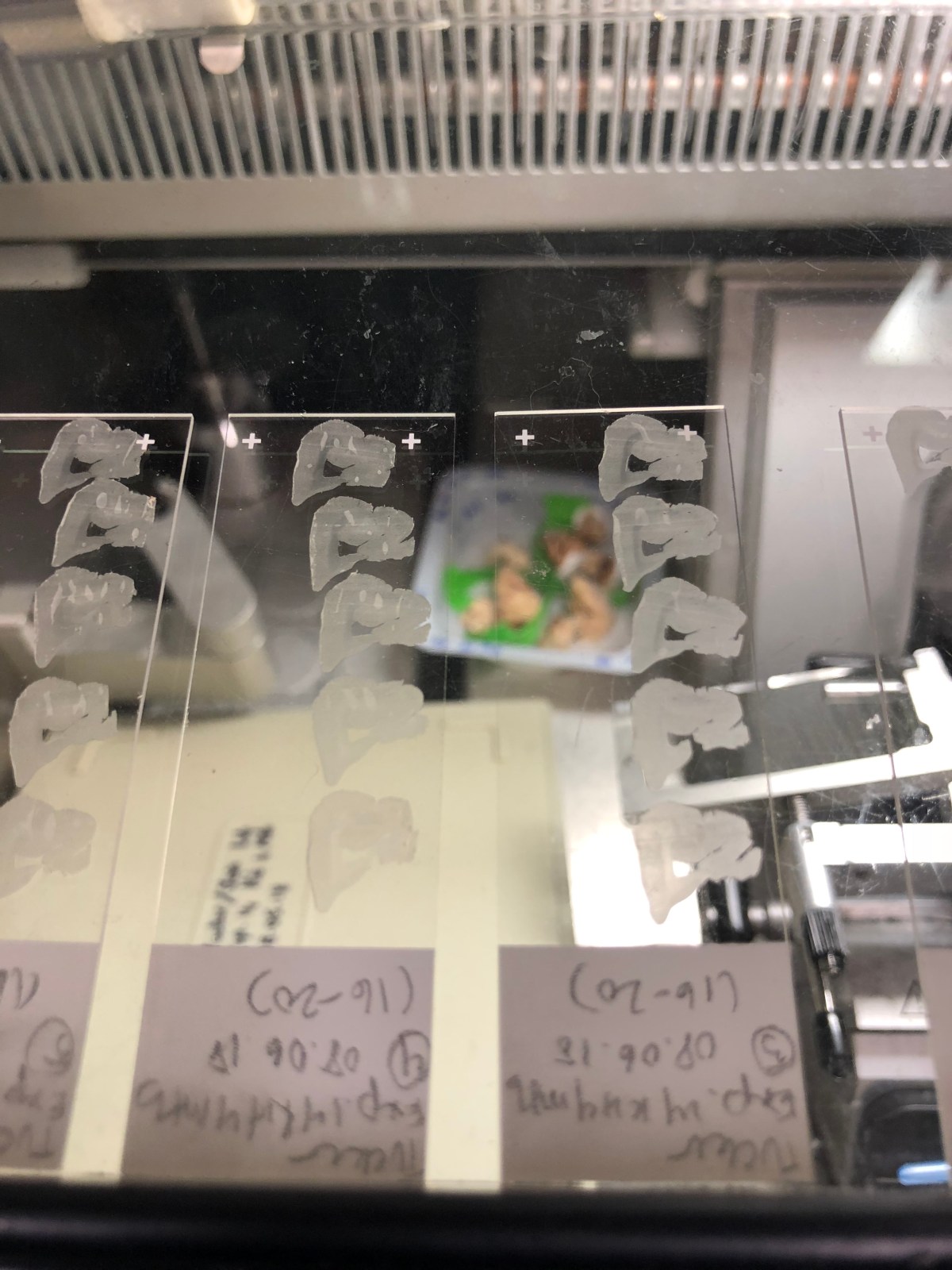
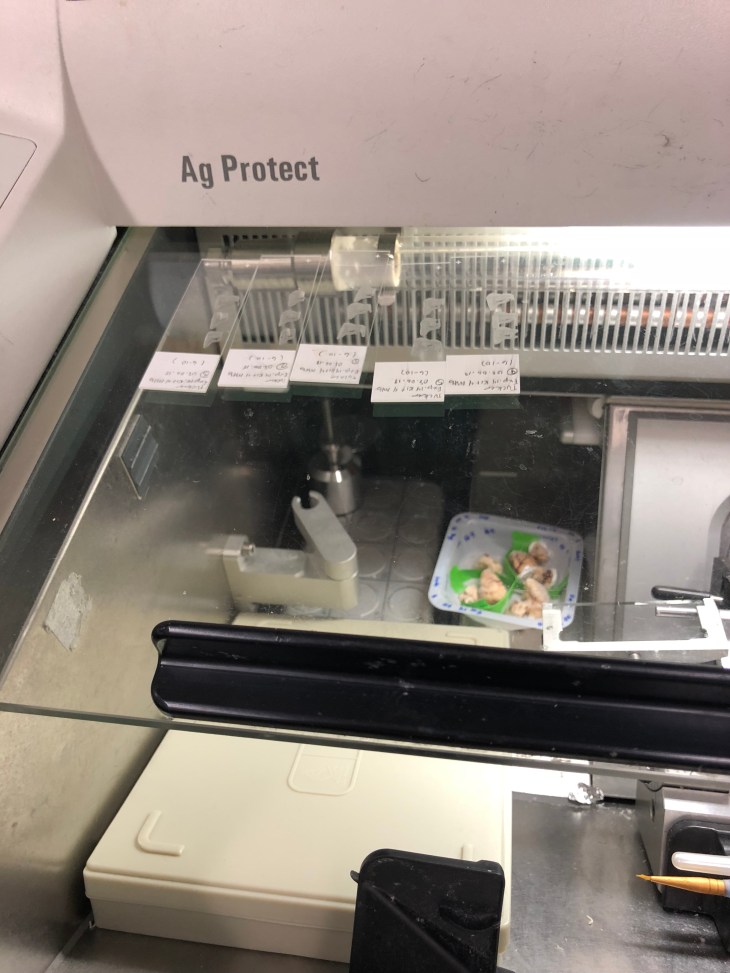
Below: What my view looked like for the day (pictured are slides on top, and sections of rabbit brains inside the cryostat, along with the slide box)

IMG_4353

Some Questions or Some Knowledge from Day 2

Today I spent a lot more time with Lisa than I did Dr. Tucker due to her demanding schedule. I got to ask Lisa some questions about her process for the lab and what her plans were.

Q: I’ve noticed there are quite a number of people working on the many elements of just this experiment alone. How many would you estimate and can it be hard working with so many people?

A: There are A LOT of people involved. It definitely can be tricky at some times, especially right now since we are supposed to have a paper finished by the end of this week, but for the most part I think we all understand that sticking to the schedule is important. For example, we sometimes ship some of our data to other facilities for testing, so sometimes we’re left hanging on data analysis for a period of time. Usually I’d say we work pretty well together otherwise. Everybody understands how crucial they are on this team.

Q: What are some of your plans right now? And how did you figure out you wanted to work with this particular team?

A: As a technician, you often have to visit a lot of labs before you can figure out where you want to work and what you want to work with. For me, I just really liked the environment of this team and they are working on a pretty interesting experiment. I’m currently working on getting my PhD, which is another 4-5 year process, so it is going to take me a while, especially while I figure out my exact specialty for the PhD. I think I’m going to focus on something in Virology, but even there there are so many branches you can choose on. It’s almost like a never ending branch of tree roots.

Other Knowledge I acquired from the day:

  • Everyone in the lab is either a PhD or a PhD student (these kids are still in their mid twenties!!)
  • There are at least 40-50 people on a team from what I have gathered, and all of them have their own specialties- so if you have 5 chemists, they all have their own unique area of study/focus,
  • Most labs are shared (the ones I’ve been to anyway), so it’s not uncommon to have a completely different company working with you on an unrelated experiment while you are in the lab too
  • The rabbits are often separated into test groups by litter; there are about 12 litters currently being tested on
  • some animals that were control or had no history of illness could end up being given away as pets after their litter is completed testing (depends on the animal too)

Day 3: Becoming Best Friends with the Cryostat

Faster & Cleaner

I was greeted by Lisa again this morning right at 8am, and was sure to ask her about the new bubbling questions I had from the night before after I left. It was nice to walk outside this morning since I knew what freezer was awaiting me.

Instead of heading directly to the lab though, we took the elevator in the Kennedy Kreiger Center to the eighth floor first to visit “the other Liz” as Lisa and Dr. Tucker jokingly called her, one of the various teammates doing more behind the scenes work. We briefly talked about what other things I could look forward to, such as the lab meeting, and potentially seeing if there was other work I could do that I qualified for with no training. For the meantime, I was more than happy to spend it in the lab using the cryostat. I assumed I would see the usual bustle of lab workers throughout the day.

The eerie service hallway lined with the freezers and labs on each side

IMG_4468.jpeg

Once Lisa and I finished up prepping the cryostat (which, I could almost do entirely by myself, as I proudly noticed), she mentioned working on some new test groups today down in the BSL3 before scurrying off to meet the other technicians involved with that group.

I began working with a new brain this time, after nearly finishing the whole right hemisphere of an infected one the previous two days. This time, I got to work on the left hemisphere of a control rabbit. I tried to observe differences between the two brains, but the most I could gather was there was less hemorrhaging (or blood) on each slice of the control rabbit. This was of course not a new discovery at all, since Dr. Tucker’s entire study was actually based on the swelling/trauma of the brain.

By the time I got to my lunch break, I had about 25 slides done, with 5 slices per slide, meaning I had cut at least 125 paper thin slices of this rabbit brain, not including the slices that didn’t work out (either I ripped it, it curled, got stuck to the metal plate, or I lost it in the process). I was definitely ready for a break.

Throughout the rest of the day, there was very limited interactions with others in the lab. The occasional passerby would come to grab something, but for the most part I just spent it slicing and accumulating slides. I set a goal to reach 50 full slides, and by the time Dr. Tucker came to get me for the end of the day, I had just reached it.

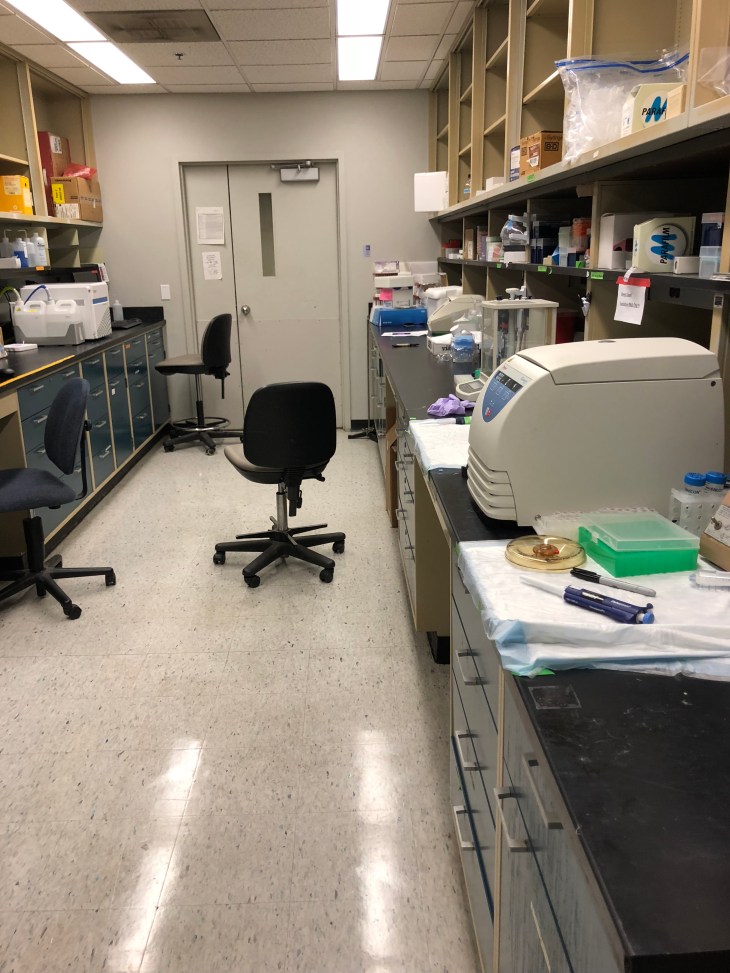
Another view of the lab I was working in

IMG_4442

Since Dr. Tucker came a bit earlier today, she helped me clean up and she showed me around some new places in the hospital, including the PICU. My mother and grandmother work at Franklin Square Hospital, so that has been the only hospital I’ve known my whole life. I was very intrigued to learn so much about a new place and finally seeing the places I had heard about so much as a child from my mother’s conferences there. In the process of the tour, I also got to meet one of Dr. Tucker’s mentors, who had just finished working with a patient.

I learned a lot about my patience today, and I think that I have gotten a lot more proficient with the cryostat which is really exciting. While today was a bit more isolated than the previous, it was a very realistic lens to see the research/lab world through. Excited to see some new things tomorrow, including the lab meeting!

My usual spot/stance for most of the day

IMG_4455

More on The Experiments & The Steps

Q: What are some of the normal things you do with the rabbits in terms of behavior or testing? What do you gain from both?

A: Well behavior happens before we test them, so we literally plop them in a clear cage and exhibit their behavior for two to three minutes. It’s quite funny really, they’re really spunky like cats. Some are sassy enough where they’ll just plop down in front of you and have a staring contest with you for those three minutes. In terms of testing, it’s also a lot of noticing the changes in those behaviors, and making sure we can find out the data necessary for treatments. We DO inject them with treatments, and there are very few. The most recent was found in 2014 that we use occasionally for a certain strain of TB, but other than that the only treatments we have are from the 1950’s or 1960’s, and they are semi-effective at best. Plus, many of these were only created from adult testing, which is why pediatric tuberculosis is our crucial studying point.

Q: What are some of the symptoms you notice when the rabbits respond to the TB?

A: Interestingly enough, a lot of the symptoms are neurological. Some rabbits often can’t use their back legs anymore because the TB has spread through their spinal cord, while others have a tilted head to one side and walk or hop in circles because of it. There are a lot of symptoms depending on the injection, and it takes 5-6 weeks for symptoms to arise.

Q: If TB often starts in the lungs or other organs, why do you directly inject it into the brain rather than observing it’s natural course?

A: Since TB wreaks so much havoc on the brain, we decided we wanted to focus directly on that, which happens much faster via a syringe to the brain. We want to focus on the inflammatory responses in the brain and surrounding lymphatic systems that eventually spread, but also work on understanding why it causes the brain’s systems to go into overdrive so fast, which ultimately causes a lot more health issues.

Day 4: ColLABoration

Lab Meetings and Research

This morning I was greeted by Dr. Tucker a few minutes before 8am.We took the winding indoor trek from the Children’s Hospital to the Kennedy Kreiger Institute, a pleasant change from the warmer, straighter outdoor trek Lisa took me on.

On our way over to the lab, we talked a bit about the optical imaging they had done recently, showing me the results of the scan on her phone. She said they were running more today looking for different nanoparticles to light up. Then she had asked me what I did the day previous, and if I was excited about the lab meeting that was happening this afternoon. I was definitely interested in seeing their meeting with multiple ends of the lab, and seeing how they work together on adapting their experiments after each trial.

I had a few quick hours of working with the cryostat and had some visitors this time as well. One was the other Liz telling me about some of the other cool projects Caroline and Miles were working on, and how she hoped to speak with them soon about adding me on to some of those adventures. She giggled and said if she can get Miles to do them correctly, she knows I could tag along in the adventures and help as well.

A little while after lunch, Dr. Tucker came down to pick me up for the lab meeting that would last until the end of my day with her. I cleaned up my station prior to her arrival so we immediately rolled out and walked about ten minutes over to the building I met some of her teammates at the first day. We walked into the meeting, and I saw many familiar faces from my past times here. Dr. Tucker briefly said each of their names again for me and told them mine, and the only new introduction I had was with one of their chemists, Ron. He was definitely one of the more aged partners there.

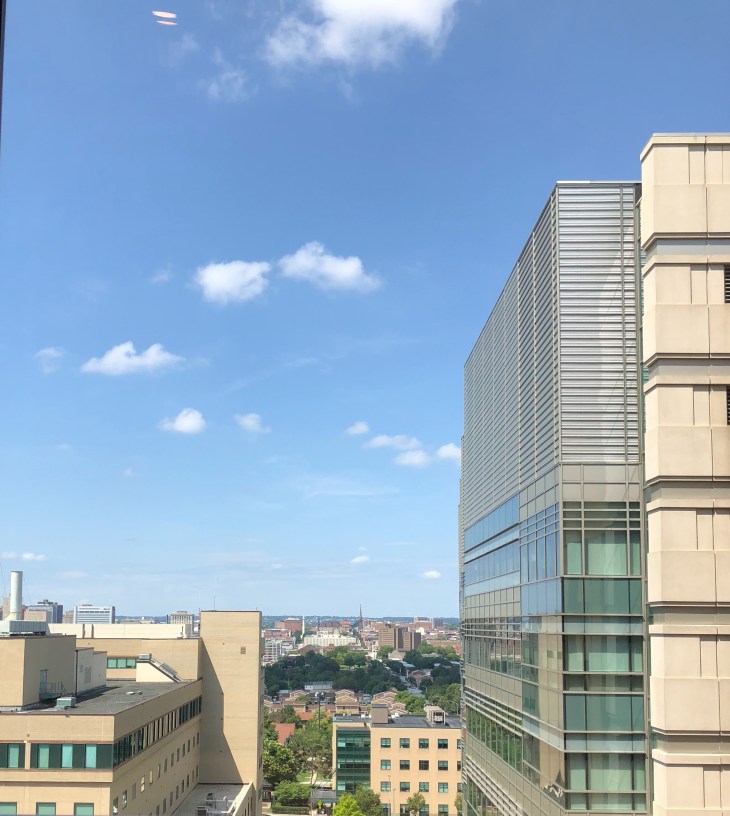
One of the Many Views I Have During the Day

img_4470-e1533864528682.jpeg

The lab meeting quickly unfolded with Dr. Jain (Dr. Tucker’s partner) and Dr. Tucker discussing the most recent data gathered, presenting it in a powerpoint presentation. Throughout the presentation, many often contributed their own ideas and possibilities for their findings, along with advising revisions to certain points or wondering what certain data meant in the long term. They divulged about what data to include in their paper (due within a week), and what they should dive deeper into for the grant one of them was writing. Dr. Tucker led most of the powerpoint while Dr. Jain contributed most of the questions and suggestions for revisions.

They soon asked for the voices of other members of the team, talking about many things such as the doses, the means of giving the drugs, translating to patients, and so much more. One would present a possibility and then another would add on until they had a detailed idea of what was happening and how they wanted to move forward with it. I was pretty pleased at how well I could keep up with the conversations and that I could understand a lot of their studies so far and what they were looking for.

By the end of the lab meeting, I was very excited about all of the work they had done in such a short amount of time. They had created a game plan for the next month (at least) in a very short period. Dr. Tucker said that it was one of their most productive meetings she’s had, and that it was great they had a strong, definitive plan moving forward. I also learned how many different types of TB there were and what medicines were effective on which kind.

Lisa and Dr. Tucker stayed after the meeting to talk about plans for tomorrow with the rabbits and with me as well. She showed me some more scans from the day and we talked to her pharmacist friend about which drugs she could mix together in one solution. Lisa also laughed at how funny some of the rabbits were, such as the one that continues to grow rather quickly despite it being infected with TB. She said, “He’s just like, whatever, TB, I’m just going to keep doin’ my thing!”

I can’t believe this day was my second to last day. I am exhausted from learning so much and seeing all of the different aspects of this lab, but it feels like I’ve been a part of this team for a long time which has made me really happy. I really enjoy everyone on this team and each one of them is unimaginably intelligent and hardworking. I can’t wait for my last day with them but it’s going to be hard not seeing the work they’ve been doing or getting updates on their progress! I am excited to bring back my knowledge from this experience and translate these role models into my own daily life at RPCS.

General Knowledge I Learned from Today

  • Dr. Tucker and Dr. Jain are currently focusing on the use of steroids with a strain of TB on the rabbits and are working to find the max effective dose
  • Today the team was working on optical imaging after injecting treatments to the rabbits to see where it had spread in the brain after 30 minutes
  • Sometimes just the treatment (to aid in fighting TB) can actually harm the animals more than TB itself does
  • Most rabbits infected do not become symptomatic, ever
  • Their most common route of treatment is through feeding the rabbits Ensure with the prescription drugs (oral vs. IV)
  • They are currently also studying the plasma levels in the carotid after injection, and are trying to tackle some confusing (or strange) data from the most recent group

Day 5: New Jobs, New Endings (for now)

The Final Hours at John’s Hopkins

Once I stepped through the doors to the Children’s Hospital this morning, I was optimistic about my last day but was also jolted by the fact that my time was coming to a close. I had already grown accustomed to the modern buildings and the winding passages between the many other research buildings and hospitals.

I met Lisa at our scheduled time and we promptly took our route to the research building where the TB research lab was, rather than our normal path to the Ross building where the cryostat was. I met Dr. Tucker as her and Lisa proceeded to work on the project they had discussed in the lab meeting the day before. They quickly did some work on concentrations of the drug regimens they were going to administer to their rabbits, and I got to see where they kept the ingredients as Dr. Tucker was going to be away while Lisa made the mixtures.

As they were doing their work on concentrations, I was surprised at how similar it was to the work I had just done in chemistry this past year, with the only difference being that it was medicine and Ensure rather than the solutions I was used to. I enjoyed seeing their work as they problem solved and worked to do the math for the proper doses and making sure they would be soluble.

Soon after that, Dr. Tucker had some things to do before leaving, and I was sure to thank her for all of her help and allowing me to shadow her this past week. She was patient with me and I really appreciate all the work she did with me!

After they were finished with those solutions, Lisa took me to the Ross building, but this time we went to the 8th floor, where Liz and her team worked. They told me they had some fun things for me to watch today, and Caroline quickly listed off some things we could do. Our first stop was heading to where some rabbits were kept and doing ultrasounds to see if any rabbits were pregnant. I was excited!

We made our way down to the holding room for the rabbits, and I saw some other animals and their holding facilities as well. The rabbits were so much quieter! We had to put on a gown, booties, gloves, and a mask before entering where the rabbits were held. Once we got in, they showed me the rabbits and their differences in size based on their age, etc. Some of these rabbits were huge! Caroline showed me where some of the younger rabbits were, and she even let me hold one for as long as I wanted. I held one all through the ultrasounds, and it even fell asleep in my arms! They all started laughing at me and calling me the rabbit whisperer.

All of the rabbits we gave ultrasounds to were pregnant. It was fascinating seeing how they can tell- mostly from the development of the spine! They said the spine develops early in the pregnancy, so its really easy to tell them apart in the ultrasound.

After we left the rabbits, we went back up to the eighth floor and ran some other tests. Caroline and I did a T-maze to study rabbit behavior. They have a camera that measures out the timing and keeps track of which way the rabbit chooses to go, and they test each rabbit multiple times. She said she really wasn’t sure how much information they could get about their behaviors from this, other than some deficiencies, but she ran the tests anyways.

Caroline spent a few minutes afterwards collecting and processing some data from various experiments, so I got to talk with Liz and Caroline a little and found out that Liz actually knows one of our assistant rowing coaches, Coach Emily! It was fun getting to learn about her rowing experiences both in Baltimore and Austin, Texas, and we both laughed at what a small world it is.

Once Caroline finished with her data and we took a small lunch break, we went to go do work on mice in one of the mice colonies. The room was nicknamed “the satellite room”, and it was crazy to see all of the mouse cages lined up against a big wall. Caroline explained to me a lot about what they were studying in the mice, which was called Rhett’s Syndrome, affecting almost entirely females. She let me weigh the mice and I wrote down the weight according to their given names, often shortened for something important, and she injected the mice with either saline (the controls) or something shortened to D-Nac for the ones susceptible to Rhett’s. She quickly told me why they were doing what they were doing while she was injecting them, and then she placed them all back into their proper cages.

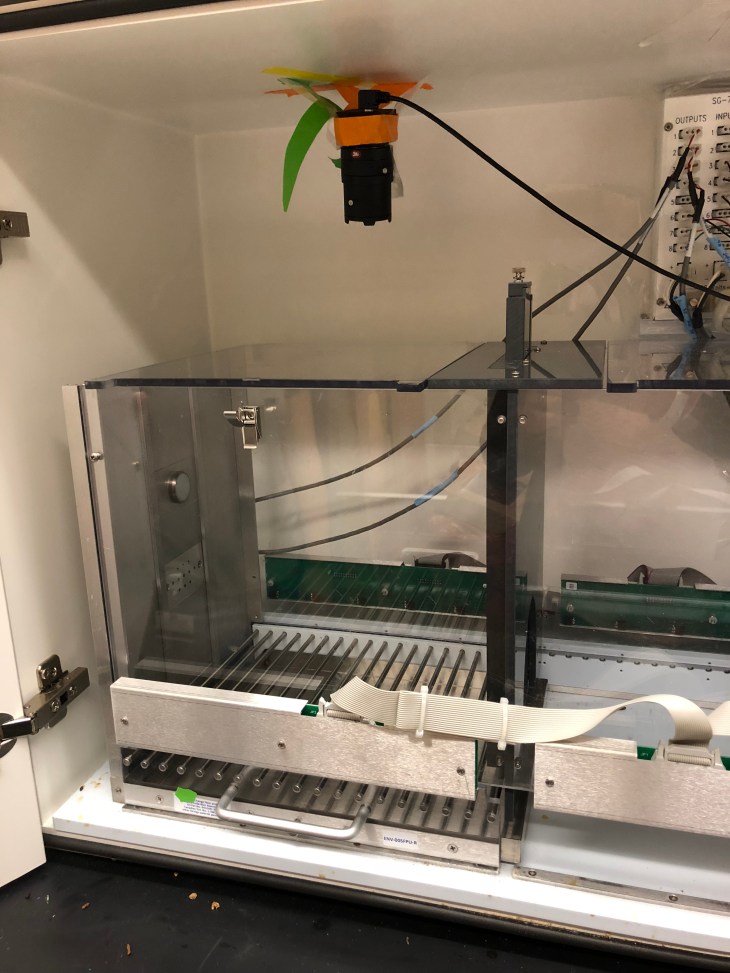
One of the various places where they test and study mice behavior

IMG_4649

She showed me around the lab a bit more afterwards, before we went back to their lab room to finish up some T-maze tests on the rabbits.

Our last adventure of the day was probably the hardest for me to adjust to, at first. Caroline needed to do surgery on a rabbit to test new EEG transmitters. In order to do that, they had to prep the rabbits for surgery. They give the rabbits a form of anesthesia, which they call ISO (isoflurane), to put them to sleep and get them into an appropriate place. This rabbit was very adamant about not going under the anesthesia, and it took close to 45 minutes to sedate it completely, which she said was the worst case she has ever had. Caroline also mentioned that rabbits were very sensitive to anesthesia and sometimes they would become hypoxic quickly and pass away, so ISO exposure was supposed to last less than an hour. Once the rabbit was finally under, she quickly began to work her way to the skull. She had to work through some muscle tissue and work to fit the transmitter under the skin, which in all honesty was hard to watch as this was my first real life experience with any type of surgical procedure. Occasionally, the rabbit would stir too which nearly broke my heart. After she had the transmitter in, she had to connect four wires to different parts of the brain. First, she did two through the muscles near the back, and then she had to use a drill to drill through the skull and put the other two wires touching the brain.

It took a fair amount of time for her to get to all of the wires, after some careful precision with the drill and suturing up the wires. I actually didn’t get to see the end of it, only because Lisa came to get me right at 4pm. I thanked Caroline for allowing me to watch her all day, and quickly left so she could finish the surgery. I hope the rabbit is doing well post-op.

The biggest dilemma for me today was definitely struggling with the testing of animals. While great research is being made and many lives have been saved, it also broke my heart to see these animals confused and in pain. I wish there was a happy medium, and a true, confident answer for it, but unfortunately I don’t think I will ever come up with a true stance on this topic.

On my way to the main entrance with Lisa, we talked about my time here, and she left me with the opportunity to volunteer anytime I wanted and if I wanted, to become BSL3 certified so I could work more with her in the lab if I ever wanted to come back. I would love to come back and work more with them if I find the opportunity, but for now, I definitely need some time to reflect on what I learned this week and processing the experiences and knowledge I gained with the work I did and what I saw.

It has been a wonderful week working in such a fascinating field of work, and I am sure I will sleep well tonight. I am exhausted!

One of the mazes- this is actually for pigs, and it can close off to create a T or other shapes

IMG_4646

Working with Caroline, with My Summarization I Hope is Accurate

Q: What do you work with on the pregnant rabbits and their babies?

A: These rabbits we’re using to study cerebral palsy. So, when these rabbits become pregnant, we do various things to study the deficiencies that make them sick until they are born with symptoms of CP. Unfortunately, after the mom has become injected with it, it makes her sick as well, so usually they only become pregnant once before we have to euthanize them due to the issues they develop.

Q: Can you tell me a little bit more about the Rhett’s Syndrome study?

A: Well we base all of these rabbits based on their genomes. Obviously they are all female as well, since it only really effects females. The CPB2 gene [working from memory] is found in the X chromosome, so if they don’t have two copies of this and only one is when we find problems and the development of Rhett’s (and males only have one X chromosome, so they naturally have double the amount of proteins to compensate, and if they don’t, they usually pass in utero). These rabbits were all genomed into “het’s” (which I believe is either heterozygous (good, two copies) or heterogenous (bad, one copy)), and we either inject them with saline if they show no deficiencies, or with D-Nac to observe the effects of it. D-Nac is two things, one being a nanoparticle that can pass the blood-brain barrier (important since the protein is found in the brain and not many medicines can pass through the barrier) and the actual medicine itself that can potentially help with these deficiencies. So we have been observing them to see what their responses are, and keeping updated on their conditions. (She also briefly explained some of the symptoms that set apart the Rhett’s mice from the others)

Q: Why do you guys place these transmitters into rabbits and what are some of the things you collect and study?

A: We run a series of EEG tests through a course of three days, and the rabbits are often sent into different tests and we study their brain waves. From their we usually study the control rabbits versus the others that could have various other issues, whether we are testing CP or any other disease. We are just mostly looking at the brain and the effects these diseases have on them.

Q: How can you see some of the disease growth in the brains of these rabbits?

A: Well Amanda (an undergrad I met today, she’s majoring in an area Neuroscience I believe) takes samples from the cryostat, stains them, and runs them through a computer software. She traces each area that lights up for this specific body and she traces it with the software. Once she has highlighted every area in that slice, the computer software can actually give you calculations in terms of the size of the bodies, and other values to give you data on that sample. We use things like this to compare and keep track of growth and areas of our experiments.