Faster & Cleaner
I was greeted by Lisa again this morning right at 8am, and was sure to ask her about the new bubbling questions I had from the night before after I left. It was nice to walk outside this morning since I knew what freezer was awaiting me.
Instead of heading directly to the lab though, we took the elevator in the Kennedy Kreiger Center to the eighth floor first to visit “the other Liz” as Lisa and Dr. Tucker jokingly called her, one of the various teammates doing more behind the scenes work. We briefly talked about what other things I could look forward to, such as the lab meeting, and potentially seeing if there was other work I could do that I qualified for with no training. For the meantime, I was more than happy to spend it in the lab using the cryostat. I assumed I would see the usual bustle of lab workers throughout the day.
The eerie service hallway lined with the freezers and labs on each side
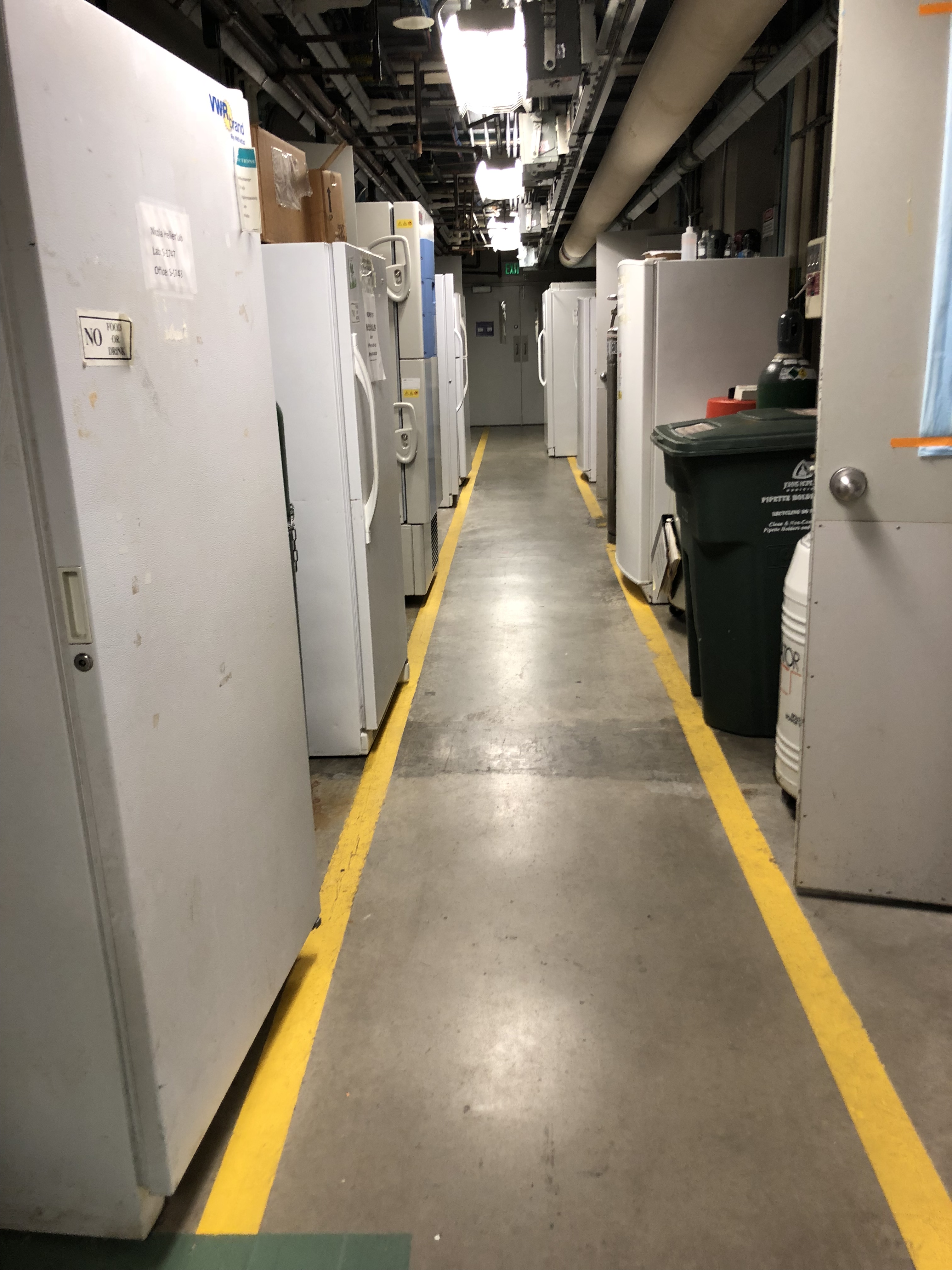
Once Lisa and I finished up prepping the cryostat (which, I could almost do entirely by myself, as I proudly noticed), she mentioned working on some new test groups today down in the BSL3 before scurrying off to meet the other technicians involved with that group.
I began working with a new brain this time, after nearly finishing the whole right hemisphere of an infected one the previous two days. This time, I got to work on the left hemisphere of a control rabbit. I tried to observe differences between the two brains, but the most I could gather was there was less hemorrhaging (or blood) on each slice of the control rabbit. This was of course not a new discovery at all, since Dr. Tucker’s entire study was actually based on the swelling/trauma of the brain.
By the time I got to my lunch break, I had about 25 slides done, with 5 slices per slide, meaning I had cut at least 125 paper thin slices of this rabbit brain, not including the slices that didn’t work out (either I ripped it, it curled, got stuck to the metal plate, or I lost it in the process). I was definitely ready for a break.
Throughout the rest of the day, there was very limited interactions with others in the lab. The occasional passerby would come to grab something, but for the most part I just spent it slicing and accumulating slides. I set a goal to reach 50 full slides, and by the time Dr. Tucker came to get me for the end of the day, I had just reached it.
Another view of the lab I was working in
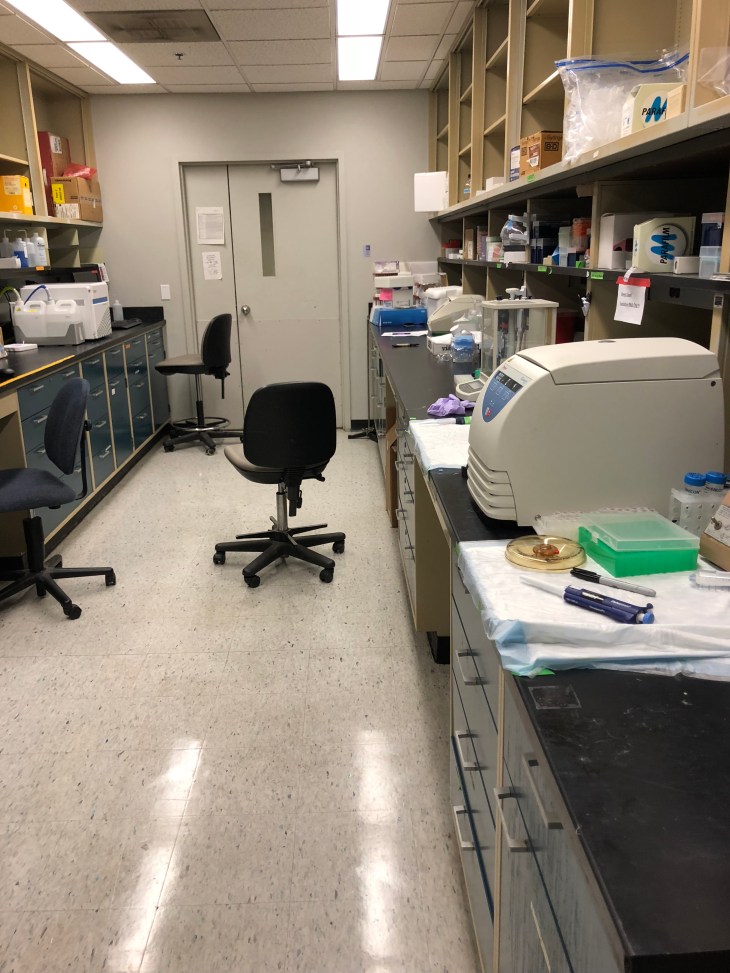
Since Dr. Tucker came a bit earlier today, she helped me clean up and she showed me around some new places in the hospital, including the PICU. My mother and grandmother work at Franklin Square Hospital, so that has been the only hospital I’ve known my whole life. I was very intrigued to learn so much about a new place and finally seeing the places I had heard about so much as a child from my mother’s conferences there. In the process of the tour, I also got to meet one of Dr. Tucker’s mentors, who had just finished working with a patient.
I learned a lot about my patience today, and I think that I have gotten a lot more proficient with the cryostat which is really exciting. While today was a bit more isolated than the previous, it was a very realistic lens to see the research/lab world through. Excited to see some new things tomorrow, including the lab meeting!
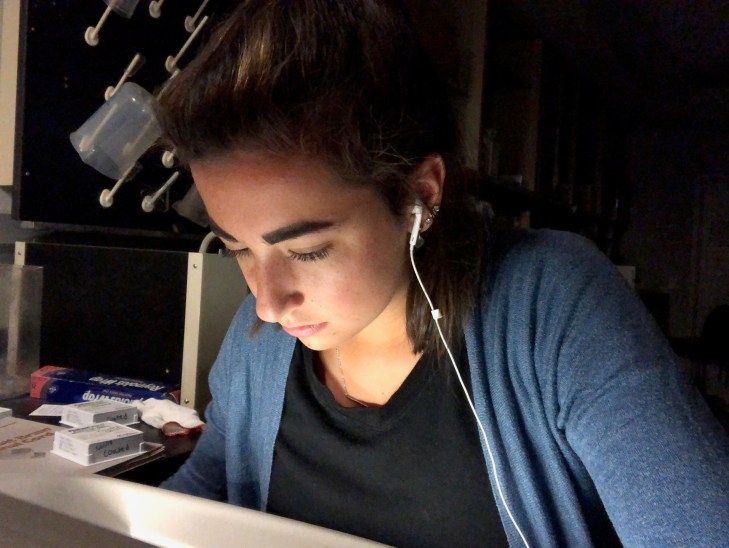
My usual spot/stance for most of the day
More on The Experiments & The Steps
Q: What are some of the normal things you do with the rabbits in terms of behavior or testing? What do you gain from both?
A: Well behavior happens before we test them, so we literally plop them in a clear cage and exhibit their behavior for two to three minutes. It’s quite funny really, they’re really spunky like cats. Some are sassy enough where they’ll just plop down in front of you and have a staring contest with you for those three minutes. In terms of testing, it’s also a lot of noticing the changes in those behaviors, and making sure we can find out the data necessary for treatments. We DO inject them with treatments, and there are very few. The most recent was found in 2014 that we use occasionally for a certain strain of TB, but other than that the only treatments we have are from the 1950’s or 1960’s, and they are semi-effective at best. Plus, many of these were only created from adult testing, which is why pediatric tuberculosis is our crucial studying point.
Q: What are some of the symptoms you notice when the rabbits respond to the TB?
A: Interestingly enough, a lot of the symptoms are neurological. Some rabbits often can’t use their back legs anymore because the TB has spread through their spinal cord, while others have a tilted head to one side and walk or hop in circles because of it. There are a lot of symptoms depending on the injection, and it takes 5-6 weeks for symptoms to arise.
Q: If TB often starts in the lungs or other organs, why do you directly inject it into the brain rather than observing it’s natural course?
A: Since TB wreaks so much havoc on the brain, we decided we wanted to focus directly on that, which happens much faster via a syringe to the brain. We want to focus on the inflammatory responses in the brain and surrounding lymphatic systems that eventually spread, but also work on understanding why it causes the brain’s systems to go into overdrive so fast, which ultimately causes a lot more health issues.
 Madison's Summer at Johns Hopkins Hospital