The Final Hours at John’s Hopkins
Once I stepped through the doors to the Children’s Hospital this morning, I was optimistic about my last day but was also jolted by the fact that my time was coming to a close. I had already grown accustomed to the modern buildings and the winding passages between the many other research buildings and hospitals.
I met Lisa at our scheduled time and we promptly took our route to the research building where the TB research lab was, rather than our normal path to the Ross building where the cryostat was. I met Dr. Tucker as her and Lisa proceeded to work on the project they had discussed in the lab meeting the day before. They quickly did some work on concentrations of the drug regimens they were going to administer to their rabbits, and I got to see where they kept the ingredients as Dr. Tucker was going to be away while Lisa made the mixtures.
As they were doing their work on concentrations, I was surprised at how similar it was to the work I had just done in chemistry this past year, with the only difference being that it was medicine and Ensure rather than the solutions I was used to. I enjoyed seeing their work as they problem solved and worked to do the math for the proper doses and making sure they would be soluble.
Soon after that, Dr. Tucker had some things to do before leaving, and I was sure to thank her for all of her help and allowing me to shadow her this past week. She was patient with me and I really appreciate all the work she did with me!
After they were finished with those solutions, Lisa took me to the Ross building, but this time we went to the 8th floor, where Liz and her team worked. They told me they had some fun things for me to watch today, and Caroline quickly listed off some things we could do. Our first stop was heading to where some rabbits were kept and doing ultrasounds to see if any rabbits were pregnant. I was excited!
We made our way down to the holding room for the rabbits, and I saw some other animals and their holding facilities as well. The rabbits were so much quieter! We had to put on a gown, booties, gloves, and a mask before entering where the rabbits were held. Once we got in, they showed me the rabbits and their differences in size based on their age, etc. Some of these rabbits were huge! Caroline showed me where some of the younger rabbits were, and she even let me hold one for as long as I wanted. I held one all through the ultrasounds, and it even fell asleep in my arms! They all started laughing at me and calling me the rabbit whisperer.
All of the rabbits we gave ultrasounds to were pregnant. It was fascinating seeing how they can tell- mostly from the development of the spine! They said the spine develops early in the pregnancy, so its really easy to tell them apart in the ultrasound.
After we left the rabbits, we went back up to the eighth floor and ran some other tests. Caroline and I did a T-maze to study rabbit behavior. They have a camera that measures out the timing and keeps track of which way the rabbit chooses to go, and they test each rabbit multiple times. She said she really wasn’t sure how much information they could get about their behaviors from this, other than some deficiencies, but she ran the tests anyways.
Caroline spent a few minutes afterwards collecting and processing some data from various experiments, so I got to talk with Liz and Caroline a little and found out that Liz actually knows one of our assistant rowing coaches, Coach Emily! It was fun getting to learn about her rowing experiences both in Baltimore and Austin, Texas, and we both laughed at what a small world it is.
Once Caroline finished with her data and we took a small lunch break, we went to go do work on mice in one of the mice colonies. The room was nicknamed “the satellite room”, and it was crazy to see all of the mouse cages lined up against a big wall. Caroline explained to me a lot about what they were studying in the mice, which was called Rhett’s Syndrome, affecting almost entirely females. She let me weigh the mice and I wrote down the weight according to their given names, often shortened for something important, and she injected the mice with either saline (the controls) or something shortened to D-Nac for the ones susceptible to Rhett’s. She quickly told me why they were doing what they were doing while she was injecting them, and then she placed them all back into their proper cages.
One of the various places where they test and study mice behavior
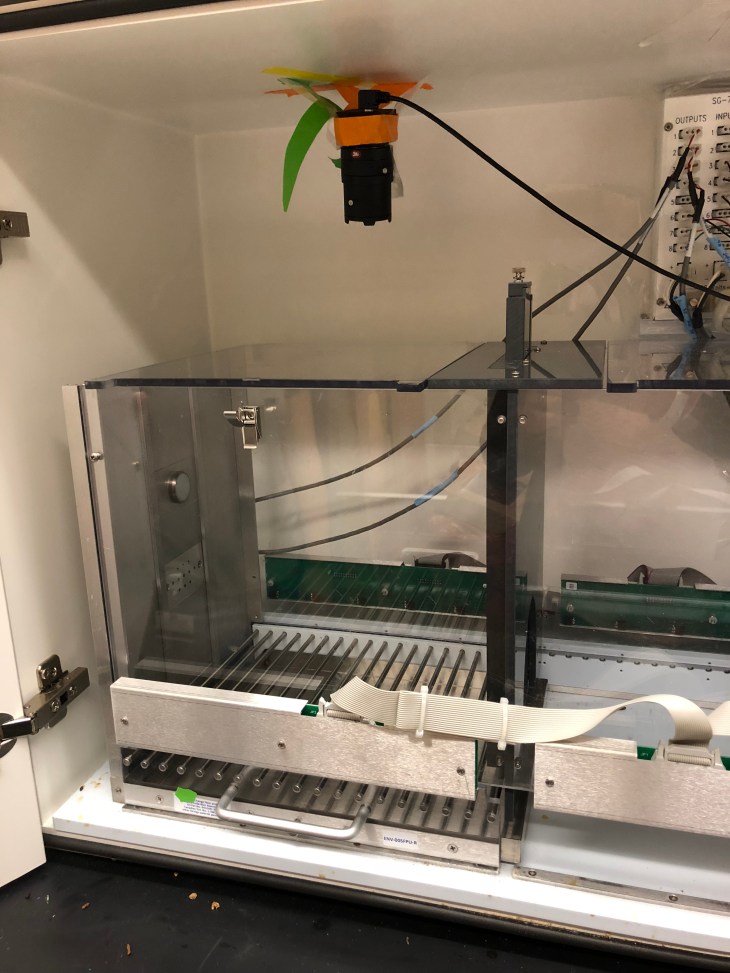
She showed me around the lab a bit more afterwards, before we went back to their lab room to finish up some T-maze tests on the rabbits.
Our last adventure of the day was probably the hardest for me to adjust to, at first. Caroline needed to do surgery on a rabbit to test new EEG transmitters. In order to do that, they had to prep the rabbits for surgery. They give the rabbits a form of anesthesia, which they call ISO (isoflurane), to put them to sleep and get them into an appropriate place. This rabbit was very adamant about not going under the anesthesia, and it took close to 45 minutes to sedate it completely, which she said was the worst case she has ever had. Caroline also mentioned that rabbits were very sensitive to anesthesia and sometimes they would become hypoxic quickly and pass away, so ISO exposure was supposed to last less than an hour. Once the rabbit was finally under, she quickly began to work her way to the skull. She had to work through some muscle tissue and work to fit the transmitter under the skin, which in all honesty was hard to watch as this was my first real life experience with any type of surgical procedure. Occasionally, the rabbit would stir too which nearly broke my heart. After she had the transmitter in, she had to connect four wires to different parts of the brain. First, she did two through the muscles near the back, and then she had to use a drill to drill through the skull and put the other two wires touching the brain.
It took a fair amount of time for her to get to all of the wires, after some careful precision with the drill and suturing up the wires. I actually didn’t get to see the end of it, only because Lisa came to get me right at 4pm. I thanked Caroline for allowing me to watch her all day, and quickly left so she could finish the surgery. I hope the rabbit is doing well post-op.
The biggest dilemma for me today was definitely struggling with the testing of animals. While great research is being made and many lives have been saved, it also broke my heart to see these animals confused and in pain. I wish there was a happy medium, and a true, confident answer for it, but unfortunately I don’t think I will ever come up with a true stance on this topic.
On my way to the main entrance with Lisa, we talked about my time here, and she left me with the opportunity to volunteer anytime I wanted and if I wanted, to become BSL3 certified so I could work more with her in the lab if I ever wanted to come back. I would love to come back and work more with them if I find the opportunity, but for now, I definitely need some time to reflect on what I learned this week and processing the experiences and knowledge I gained with the work I did and what I saw.
It has been a wonderful week working in such a fascinating field of work, and I am sure I will sleep well tonight. I am exhausted!
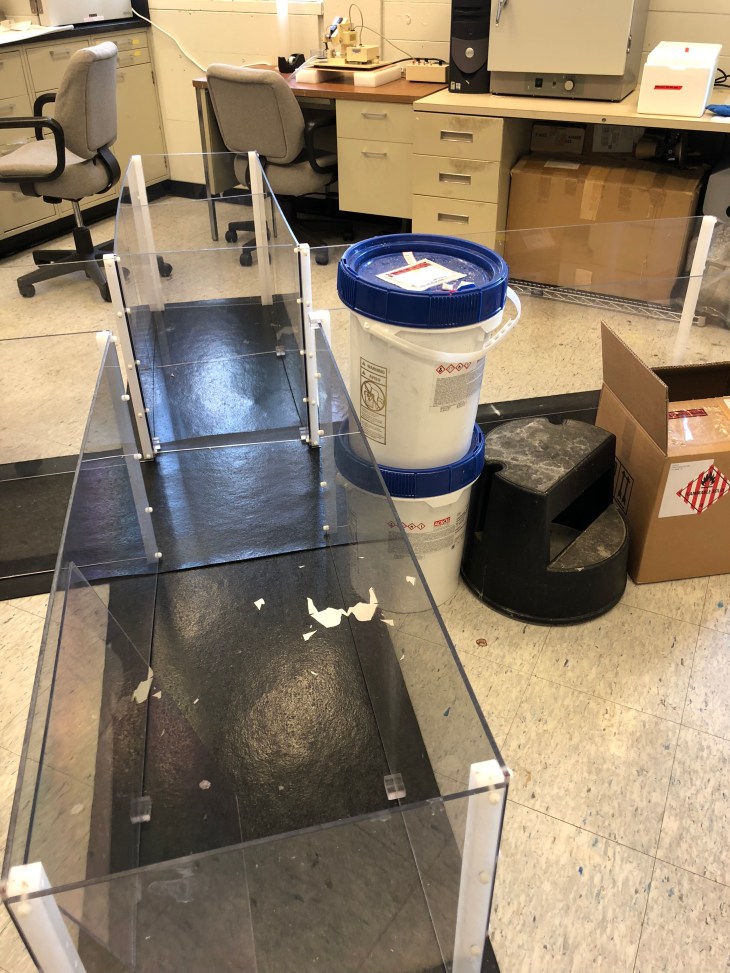
One of the mazes- this is actually for pigs, and it can close off to create a T or other shapes
Working with Caroline, with My Summarization I Hope is Accurate
Q: What do you work with on the pregnant rabbits and their babies?
A: These rabbits we’re using to study cerebral palsy. So, when these rabbits become pregnant, we do various things to study the deficiencies that make them sick until they are born with symptoms of CP. Unfortunately, after the mom has become injected with it, it makes her sick as well, so usually they only become pregnant once before we have to euthanize them due to the issues they develop.
Q: Can you tell me a little bit more about the Rhett’s Syndrome study?
A: Well we base all of these rabbits based on their genomes. Obviously they are all female as well, since it only really effects females. The CPB2 gene [working from memory] is found in the X chromosome, so if they don’t have two copies of this and only one is when we find problems and the development of Rhett’s (and males only have one X chromosome, so they naturally have double the amount of proteins to compensate, and if they don’t, they usually pass in utero). These rabbits were all genomed into “het’s” (which I believe is either heterozygous (good, two copies) or heterogenous (bad, one copy)), and we either inject them with saline if they show no deficiencies, or with D-Nac to observe the effects of it. D-Nac is two things, one being a nanoparticle that can pass the blood-brain barrier (important since the protein is found in the brain and not many medicines can pass through the barrier) and the actual medicine itself that can potentially help with these deficiencies. So we have been observing them to see what their responses are, and keeping updated on their conditions. (She also briefly explained some of the symptoms that set apart the Rhett’s mice from the others)
Q: Why do you guys place these transmitters into rabbits and what are some of the things you collect and study?
A: We run a series of EEG tests through a course of three days, and the rabbits are often sent into different tests and we study their brain waves. From their we usually study the control rabbits versus the others that could have various other issues, whether we are testing CP or any other disease. We are just mostly looking at the brain and the effects these diseases have on them.
Q: How can you see some of the disease growth in the brains of these rabbits?
A: Well Amanda (an undergrad I met today, she’s majoring in an area Neuroscience I believe) takes samples from the cryostat, stains them, and runs them through a computer software. She traces each area that lights up for this specific body and she traces it with the software. Once she has highlighted every area in that slice, the computer software can actually give you calculations in terms of the size of the bodies, and other values to give you data on that sample. We use things like this to compare and keep track of growth and areas of our experiments.
 Madison's Summer at Johns Hopkins Hospital